
Why Bay Area Flood Risk Is Not Just Coastal
San Francisco Bay Area
October 25, 2026
When people hear “flood risk,” they often picture a shoreline, a creek, or a property located inside a mapped floodplain.
That is only part of the problem.
During a strong El Niño winter, coastal flooding, high tides, atmospheric rivers, saturated soils, creek overflow, storm-drain backups, and property-level drainage failures can overlap. A home does not need to sit directly on the Bay to experience water-related damage.
Recent reporting has identified vulnerable locations around San Francisco Bay, Oakland, Alviso, San Jose, Santa Cruz, San Rafael, Highway 37, and other low-lying areas. Forecast reporting has also described a potential shift toward wetter and stormier conditions across California. (San Francisco Chronicle: These California highways are most at risk of flooding during El Niño storms) (San Francisco Chronicle: California’s storm door is about to swing wide open) (sfchronicle.com)
But regional flood risk and property-level drainage risk are not the same thing.
Coastal flooding is only one category of risk
Coastal and tidal flooding can affect:
- Bayfront neighborhoods;
- Low-lying roads and infrastructure;
- Airports;
- Industrial areas;
- Marshlands;
- Shoreline homes; and
- Areas near tidal channels.
High tides can reduce the ability of creeks, storm drains, and rivers to discharge water. When heavy rain arrives at the same time, the system has less capacity to move water away.
That is why a storm can create problems far beyond the exact shoreline.
However, most Bay Area homeowners are not dealing with only coastal flooding. Many properties experience a different kind of water problem: localized drainage failure around the house.
Inland properties can still have serious drainage problems
A home in Oakland, San Leandro, Hayward, Berkeley, Fremont, San Jose, or another inland community may never experience coastal flooding and still have water damage beneath the structure.
Common causes include:
- Ground that slopes toward the foundation;
- Downspouts discharging at the wall;
- Concrete or pavers directing water toward the house;
- Low areas beside the foundation;
- Poorly functioning French drains;
- Blocked or undersized drainage pipes;
- Retaining walls without effective drainage;
- Sump pumps discharging into unsuitable locations;
- Irrigation leaks;
- Saturated clay soil; and
- Crawl-space vents or openings allowing water to enter.
These problems are usually too localized to be represented accurately by a broad regional flood map.
The water may collect in one side yard, behind one retaining wall, or beneath one portion of the crawl space. It may never spread across the neighborhood. But repeated exposure can still damage the property.
For more on this issue, see Why Is There Standing Water Under My House?.
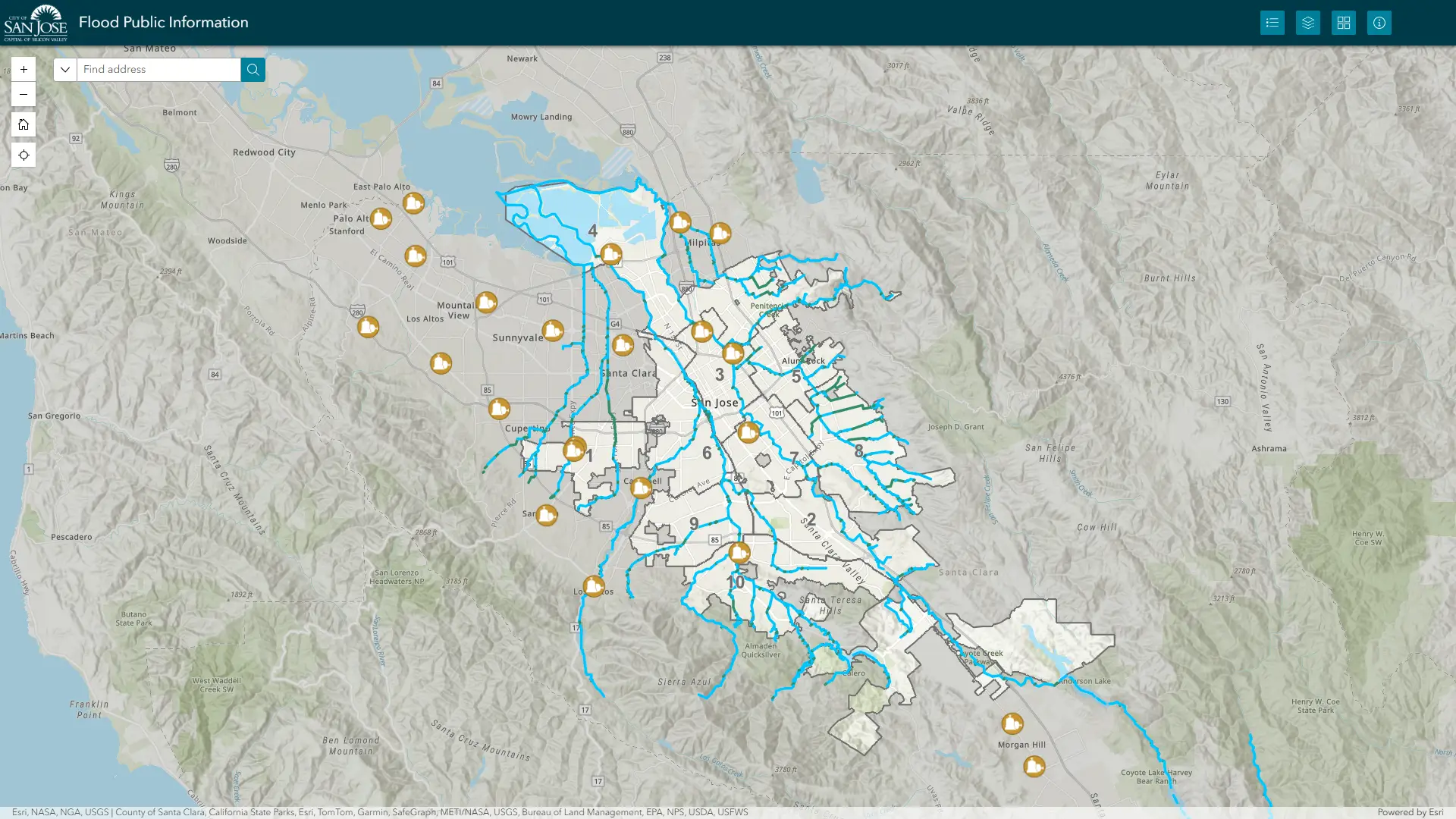
A flood map is useful, but it cannot inspect your lot
San Jose residents can use local flood-risk mapping to understand broader neighborhood conditions. That is a smart first step. You can also read our related article, What a San Jose Flood Map Can Tell You About Your Home, and What It Cannot.
But a map generally cannot tell you:
- Whether your lot slopes toward the home;
- Whether the foundation is lower than the surrounding grade;
- Whether the crawl-space soil becomes damp after rain;
- Whether a retaining wall has a functioning drain;
- Whether a buried drain is clogged or incorrectly installed;
- Whether a sump pump has a reliable discharge path;
- Whether water is entering through a crack or joint;
- Whether an existing waterproofing system is installed correctly;
- Whether prior foundation work addressed the cause of movement; or
- Whether the home has existing settlement or seismic vulnerabilities.
Those questions require a property-specific evaluation.
The three main ways water reaches a home
1. Surface water
Surface water comes from rain falling on:
- Roofs;
- Driveways;
- Patios;
- Sidewalks;
- Retaining walls;
- Sloped yards; and
- Neighboring properties.
The key issue is where that water travels.
A downspout can be working exactly as designed while still discharging in the wrong location. A concrete walkway can look properly finished while directing water toward the foundation. A yard can appear nearly level while sending water toward the lowest part of the crawl space.
2. Subsurface water
Subsurface water can move through soil and collect against:
- Foundation walls;
- Retaining walls;
- Basement walls;
- Footings;
- Crawl-space slabs; and
- Buried drainage systems.
This is where many homeowners discover that adding a surface coating does not solve the problem. If water pressure remains behind a wall, the wall still has to resist that pressure.
Our article When Waterproofing Makes Things Worse: Drain Boards Installed on the Wrong Side of the Foundation explains why waterproofing must be coordinated with the direction of water movement, drainage, and the actual foundation assembly.
3. Plumbing and mechanical sources
Not all crawl-space water comes from rain.
Other possible sources include:
- Plumbing leaks;
- HVAC condensate;
- Water-heater discharge;
- Irrigation lines;
- Broken sewer or waste lines;
- Failed sump pumps; and
- Improperly connected drainage pipes.
Before designing a major drainage system, the source needs to be identified. Otherwise, the property owner may pay for an expensive system that does not address the actual problem.
Water can create foundation and settlement problems
Repeated moisture changes soil behavior. Clay soils can expand and contract as their moisture content changes. Other soils can soften, erode, or lose bearing capacity when saturated.
The result may include:
- Foundation settlement;
- Differential movement;
- Cracks;
- Porch movement;
- Leaning retaining walls;
- Sloping floors;
- Sticking doors;
- Separation at trim or wall joints; and
- Changes in crawl-space clearances.
These symptoms do not automatically prove that the foundation must be replaced. They do indicate that the water, soil, and structure should be evaluated together.
Related reading:
- How Soil Affects Foundation Stability and When Repairs Are Required
- Clay Soil and Seasonal House Movement in the Bay Area: What’s Normal?
- Why Is My Retaining Wall Leaning?
- Why Are My Floors Sloping in the Bay Area?
- Why Do My Doors Suddenly Stick in the Bay Area?
Drainage also affects seismic work
Drainage and seismic safety are not identical problems, but they can affect one another.
A wet or deteriorated foundation may not provide the same reliable connection as a sound foundation. A leaning cripple wall, shifted mudsill, corroded hardware, or weakened framing connection may be more difficult to evaluate when crawl-space conditions are wet or inaccessible.
Drainage work may also affect future seismic work by:
- Exposing or undermining footings;
- Requiring trenching beside foundation walls;
- Changing crawl-space access;
- Altering soil conditions;
- Removing or covering existing hardware; or
- Concealing conditions before they are documented.
That is why it can be a mistake to install drainage, encapsulate a crawl space, or complete a retrofit without understanding the other systems first.
See El Niño Is Strengthening: What Bay Area Homeowners Should Do About Drainage, Foundations, and Seismic Safety and The Hidden Systems Under Your Home That Free Estimates Ignore.
Why quick estimates miss localized flood risk
A short contractor visit may identify an obvious downspout, crack, or damp area.
It may not determine:
- Where water originates;
- Whether the foundation has moved;
- Whether the drainage system discharges properly;
- Whether the soil is saturated;
- Whether a retaining wall is carrying water pressure;
- Whether previous repairs were correctly installed; or
- Whether drainage should be coordinated with foundation or seismic work.
A one-line recommendation such as “install a French drain” is not a complete plan.
The design should account for trench location, depth, slope, discharge, access, soil, existing footings, utilities, foundation conditions, and future maintenance.
Our article Why Handyman Pricing Articles Mislead California Homeowners and Break the Rules explains why broad pricing claims often leave out the site conditions that determine the real cost.
What to check before the next major storm
Walk the property and look for:
- Water flowing toward the foundation;
- Downspouts discharging beside the home;
- Ponding near crawl-space vents or doors;
- Cracked or deteriorated foundation concrete;
- Efflorescence or staining;
- Damp or musty crawl-space conditions;
- Rusted structural hardware;
- Soil covering too much of the foundation;
- A retaining wall with no visible drainage outlet;
- A sump pump without a reliable discharge line;
- Drainage outlets that are blocked or buried; and
- Previous waterproofing that may have concealed the original water source.
Do not wait for the first major storm to discover that the drainage system cannot handle the flow.
A practical order of operations
For many properties, the correct sequence is generally:
- Identify the source and direction of water;
- Inspect the foundation, retaining walls, crawl space, and accessible framing;
- Confirm whether the soil or structure has moved;
- Correct grading and roof-water discharge;
- Repair or install drainage systems;
- Address foundation deterioration or settlement;
- Coordinate leveling where necessary;
- Complete seismic or structural reinforcement;
- Confirm that the crawl space is drying properly; and
- Complete encapsulation, insulation, or finish work after moisture control is established.
The exact sequence depends on the property. The point is simple: do not install one system in a way that blocks access to, damages, or conceals another.
What Avant-Garde evaluates
A Drainage & Moisture Safety Visit may include review of:
- Exterior grades;
- Downspouts;
- Roof-water discharge;
- Hardscape slopes;
- Retaining-wall drainage;
- Crawl-space moisture;
- Foundation conditions;
- Soil and settlement indicators;
- Existing French drains;
- Sump pumps and discharge;
- Prior waterproofing;
- Access and maintenance concerns; and
- The relationship between drainage, foundation, and seismic conditions.
The evaluation is intended to produce a property-specific plan, not a generic recommendation.
You receive documented findings, photographs, practical sequencing, and proposals that can be used to decide what should be addressed now, what can be phased, and what requires further engineering or specialist review.
Flood risk is local, even when the storm is regional
A strong El Niño may affect the entire region, but the consequences are determined property by property.
One home may have water moving away from the foundation. Another may have water collecting beneath the floor. One retaining wall may have a working drain. Another may be holding saturated soil with no reliable pressure relief.
That difference is why a regional flood map and a property-specific drainage evaluation serve different purposes.
Use the map to understand broader risk. Then inspect the actual property before committing to expensive repairs.
If you want to request a property-specific evaluation, fill out the form here:
Request a Drainage & Moisture Safety Visit
To see availability and book directly:
Related Reading
- El Niño Is Strengthening: What Bay Area Homeowners Should Check Before the First Major Storm
- California Declares a State of Emergency Ahead of El Niño: What Bay Area Homeowners Should Check Now
- El Niño-Driven Kelvin Wave Could Raise Bay Area Sea Levels by Up to One Foot
- How We Work to Earn, Not Assume, Your Trust
- Is Avant-Garde the Right Contractor for Your Home? The Avant-Garde Dossier
- Lead, Asbestos, and Silica: Three Health Hazards Homeowners Should Ask About Before Hiring a Contractor
This article provides general construction information. It is not a structural-engineering report, geotechnical report, legal advice, medical advice, flood determination, or guarantee of future weather or property performance.