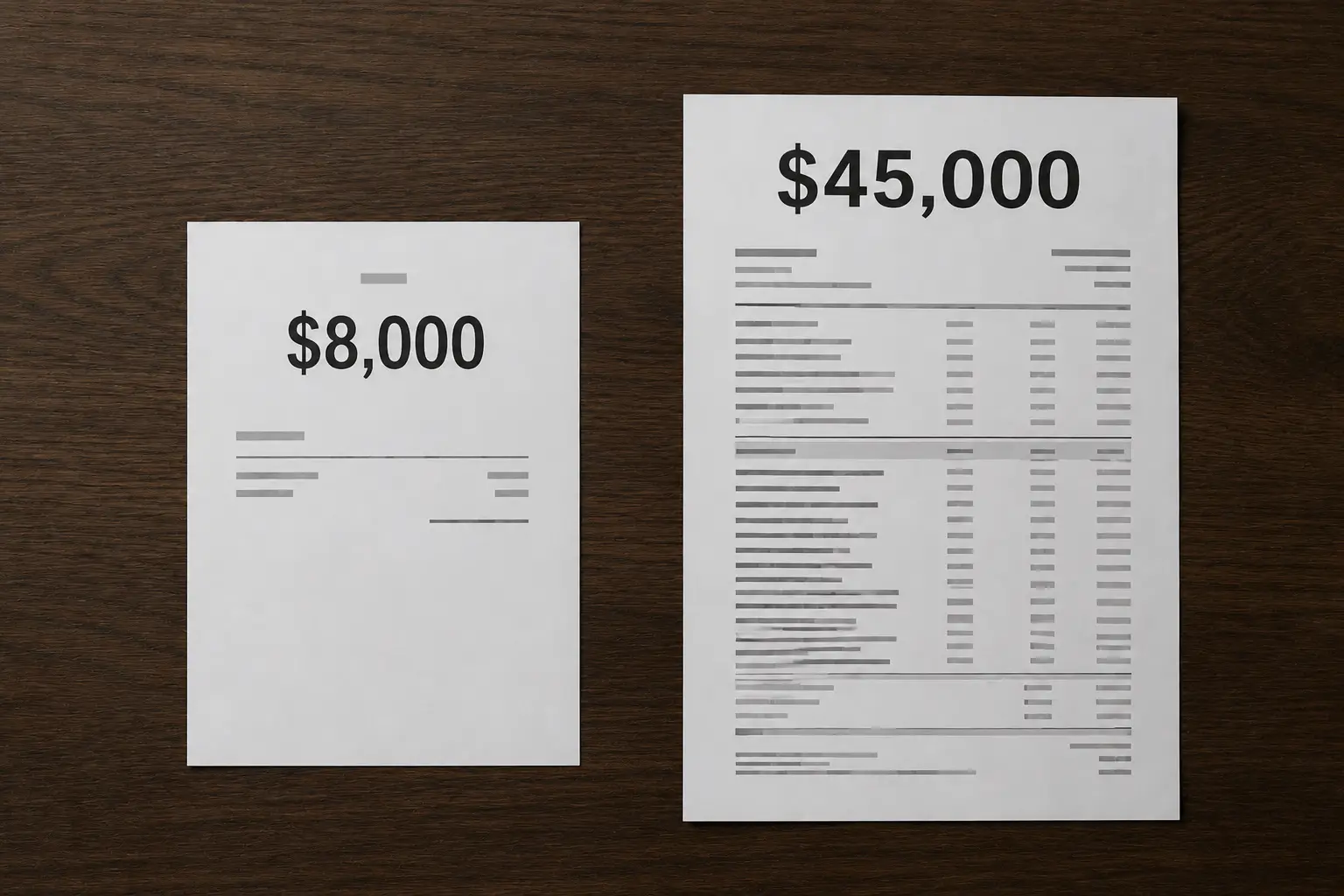
Why Is One Seismic Retrofit Bid $8,000 and Another $45,000?
If you’ve gotten more than one seismic retrofit bid in the Bay Area, you’ve probably had this experience:
- Contractor A: $8,000
- Contractor B: $22,000
- Contractor C: $45,000
All for the same house.
It feels like someone is either ripping you off… or missing something big.
Here’s the truth: those numbers are usually not for the same work, same standard, or same level of protection. They’re different answers to different questions.
This article breaks down why bids vary so much and how to compare them so you don’t overpay or under‑protect.
1. The 3 Hidden Questions Behind Every Bid
Every retrofit bid is (silently) answering three questions:
- What level of design are we using?
- Bare‑minimum Plan Set A?
- FEMA P‑1100‑informed?
- Engineered, site‑specific?
- What are we assuming about your foundation, framing, and drainage?
- “Good enough, don’t worry about it”?
- “We’re actually going to fix what’s wrong first”?
- How are we staffing and running this job?
- Legal employees, insurance, workers’ comp, supervision?
- Or the fastest/cheapest possible labor with no safety net?
Until you see how each contractor answered those questions, the numbers are meaningless.
2. Scope: What’s Actually Included?
Low bids often:
- Only cover part of the crawl space or wall length
- Use the minimum number of anchors and connectors
- Ignore cripple walls, posts, beams, or drainage
- Treat everything as if Plan Set A were always enough
Higher bids often:
- Cover more of the perimeter and key load paths
- Include more hardware (anchors, clips, hold‑downs, blocking)
- Consider FEMA P‑1100‑2A/2B guidance where Plan Set A is outdated
- Integrate framing repairs and sometimes drainage or foundation work
You’re not paying more for the same thing. You’re paying for more work and a higher standard.
For context on how we think about these levels:
Do I Need an Engineer, Plan Set A, or FEMA P‑1100 for My Bay Area Seismic Retrofit?
Seismic, Foundation & Drainage Services
3. Foundation Condition: What Are They Bolting To?
This is the biggest cost driver that rarely makes it into a one‑page bid.
Cheaper bids typically assume:
- The foundation is “fine”
- Any cracks or spalling are “just cosmetic”
- Mudsills at/near grade are “not a big deal”
Higher bids often:
- Acknowledge real damage (spalling, delamination, significant cracking)
- Include repair, capping, sistering, or replacement work
- Address mudsills at or below grade and moisture exposure
You’ll see this reflected clearly in:
- Foundation Services: Repair, Replace & Reinforce in the Bay Area
- Water Damage in Concrete Foundations: Causes & Signs
If one contractor is saying “foundation is fine” after a 2‑minute look, and another is giving you a photographed, documented explanation of why it isn’t, that explains a lot of the price gap.
4. Drainage & Moisture: Ignored or Integrated?
Low bids usually:
- Ignore drainage completely
- Don’t ask whether there’s water under the house
- Don’t talk about how water affects soil, concrete, and hardware
Higher bids often:
- Note standing water, damp soil, or efflorescence
- Integrate drainage improvements (French drains, sumps, grading)
- Design hardware and coatings for the actual moisture level
Drainage isn’t a luxury add‑on. It’s part of the structure’s long‑term survival:
A bid that includes real drainage work will always be more expensive than one that pretends water isn’t there.
5. Hardware, Fasteners, and Corrosion Protection
Two proposals might both say “L‑brackets and bolts” but deliver totally different realities.
Common low‑bid shortcuts:
- Nails instead of structural screws
- Standard zinc connectors in damp crawl spaces
- 4″ concrete screws where 4″ of embedment is required in the concrete
- Little or no thought given to corrosion over 10–20+ years
Higher‑quality bids typically:
- Specify structural connector screws and correct patterns
- Use hot‑dip galvanized or stainless hardware where needed
- Detail spacing that actually matches manufacturer and/or engineering guidance
For why this matters so much:
- Why Structural Screws are Better than Nails for Seismic Retrofits
- Screw and Nail Spacing Matters More than You Might Think
Hardware is cheap compared to everything else. If a bid is “saving money” there, it’s cutting into performance, not just margin.
6. Labor, Insurance, and Compliance
This is the part nobody advertises, but it’s real.
Ultra‑low bids are often subsidized by:
- Paying workers under the table
- No (or fake) workers’ comp
- Minimal or no liability insurance
- Rushed work with little or no QC
Higher bids from legitimate firms include:
- Licensed contractor oversight
- Legal employees on payroll
- Real workers’ comp and liability coverage
- Time for documentation and quality control
If someone is dramatically cheaper, they’re saving on something. If it’s wages, taxes, and insurance, that risk lands on you.
Read more here:
Contractor Tax & Insurance Fraud in Bay Area Construction
7. Why Free 10–15 Minute “Retrofit Estimates” Are So Misleading
A 10–15 minute free estimate is structurally incapable of:
- Evaluating full crawl‑space conditions
- Assessing foundation damage properly
- Understanding drainage and soil behavior
- Deciding between Plan Set A, FEMA, or engineering
That’s why you see wild bid swings: everyone is guessing about different invisible factors.
The only way to get apples‑to‑apples bids is to start with a real evaluation:
- Free Estimates vs. Real Evaluations: How to Choose the Right Path for Bay Area Seismic & Foundation Work
- Why Site Consultation Fees Are Worth It for Seismic Work
8. How to Compare an $8,000 Bid and a $45,000 Bid Intelligently
When you get dramatically different numbers, ask each contractor:
- What areas of the house are you retrofitting (exactly)?
- Are you assuming my foundation is sound, or are you including repairs?
- Are you addressing drainage or just ignoring water issues?
- What hardware and fasteners are you using (brand, model, coating)?
- Are your workers employees with workers’ comp, or subs/cash?
- Are you basing this on Plan Set A only, or also on FEMA P‑1100 / engineering?
- What documentation do I get (drawings, photos, hardware schedule)?
Then compare answers, not just prices.
9. What To Do Next
If you’re in the San Francisco Bay Area and staring at wildly different bids:
- Get a proper evaluation first.
Don’t let each contractor make different unseen assumptions. Start here:
Seismic, Foundation & Drainage Services - Use that evaluation as the baseline scope.
Then have contractors price that scope, not whatever they came up with in a 10‑minute visit. - If you already had a retrofit and something feels off, verify it.
That’s what Seismic Truth Audits™ are for:
Seismic Truth Audits™
The gap between an $8,000 bid and a $45,000 bid isn’t just about margin. It’s about how much house is really being protected, on what kind of foundation, with what level of honesty and skill. Once you see that, the “cheapest” option stops looking like a deal.