Seismic Truth Audits™

Avant-Garde Construction Enterprise is the creator of the Seismic Truth Audit™.

The Seismic Truth Audit™ is a paid, deep‑dive evaluation of your home’s existing earthquake retrofit that replaces quick “free estimates/ assessments” with hard evidence.


We will evaluate your existing seismic retrofit, create a to‑scale drawing of your home, take 100+ labeled photos, and document issues with exact code/manufacturer citations.

You then get a clear, prioritized retrofit plan and an itemized proposal, so you can protect your home with confidence.


There are specialty licenses for almost everything in construction, and yet, sadly, there is none for seismic retrofitting.


Most inspectors take a quick, cursory check; sometimes they do not even do that.


You can not reply on the building department, the inspector, EBB, FEMA, CEA, the CSLB, etc. to ensure the proper requirements are actually met or to enforce correction action for non-compliant work.


Please be wary of proposals that do not list specifics, and only include wording such as “compliant with Plan Set A and/ or Chapter A3” as this does not demonstrate exactly what they intend to do and is based on them correctly understanding the requirements. 


In fact, many contractors actually use these terms interchangeably even though they do not mean the same thing.


Although there may be times when some of the work overlaps, a Chapter A3 retrofit is not a Plan Set A retrofit, and vice-versa.


We’ve been hired to evaluate other “leading” retrofit contractor’s work, and have found incorrectly installed work on every seismic retrofit we have looked at.


Your family and loved ones deserve the very best when it comes to seismic protection.

Here are some common installation errors found during our Seismic Truth Audits:

Violation-3
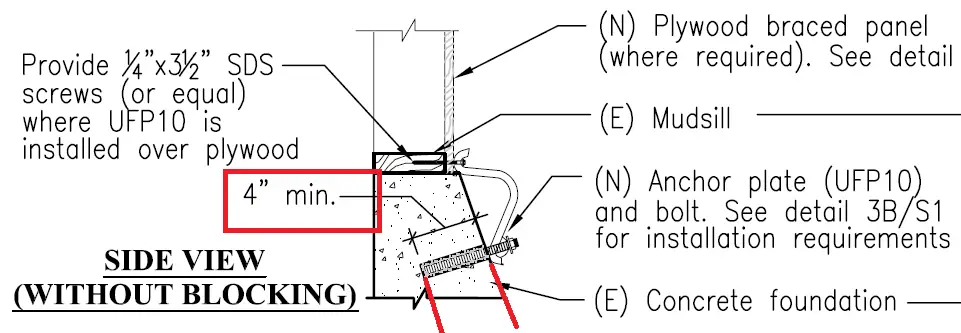
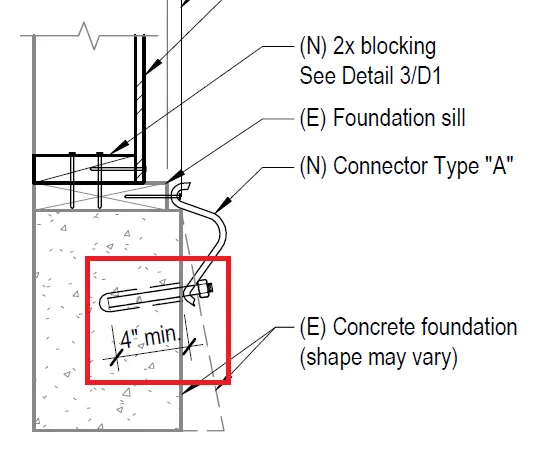
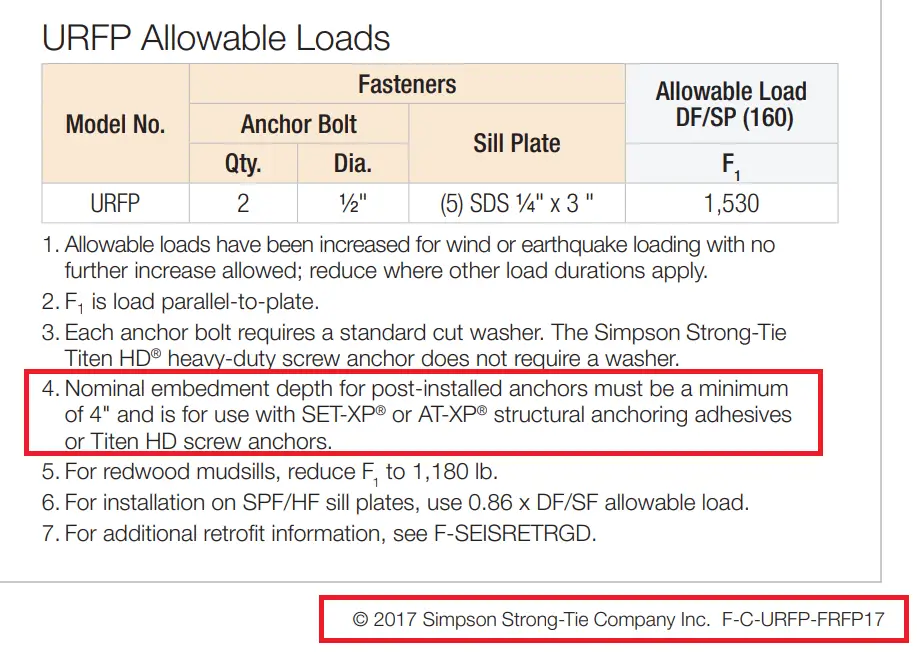
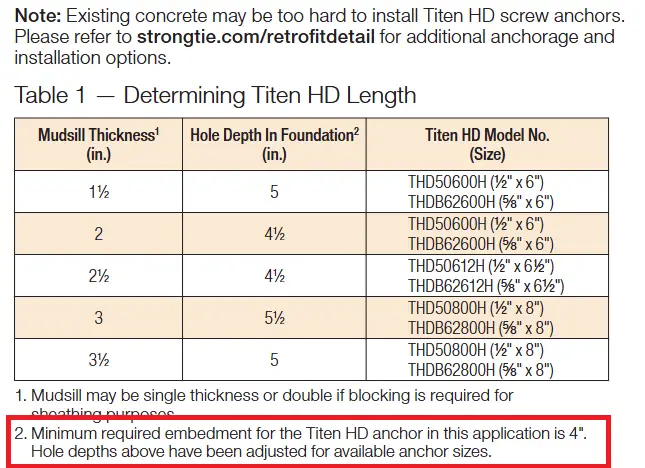
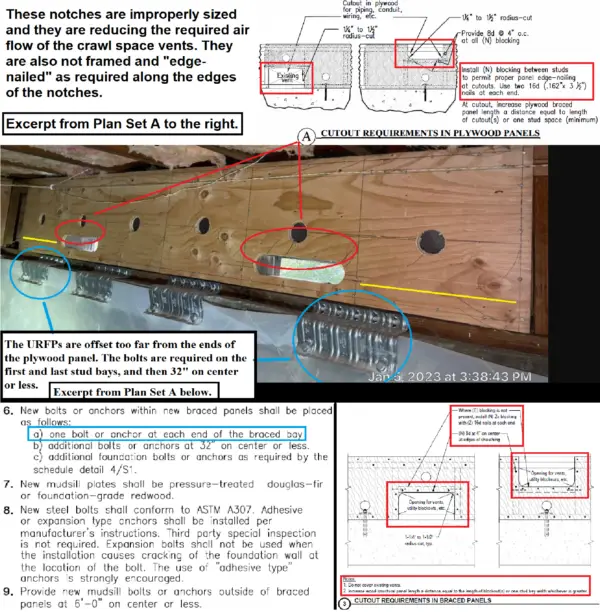
There were existing FRFPs on this retrofit that were previously installed incorrectly. The new URFPs were also installed incorrectly. The URFPs were not installed within the required clearance to the edge of the mudsill. Additionally, 4″ Titen HDs were installed, but yet Plan Set A (which was used) requires the bolt to be installed with 4″ embedment in the concrete. Even in a “perfect installation” a 4″ Titen HD can not be installed with 4″ embedment as the URFP thickness is not zero. When installed in this manner, the Titen HD especially does not have the required embedment. Others will argue Simpson Strong-Tie allows use of the 4″ Titen HD in some of their literature; however, you will find it is more commonly required to actually have 4" minimum embedment in the concrete. Please see the excerpts below from Plan Set A, FEMA P-1100-2A, and Simpson Strong-Tie literature. The most strict requirements must always be met– not the most relaxed. No matter how you try to put it, this is an incorrect installation. Please continue below to see more photos from this same project. Overall, this entire project is noncompliant, and yet was approved by the local building department, EBB, & FEMA.
Excerpt from Plan Set A
Excerpt from Plan Set A showing 4" required embedment.
Excerpt from FEMA P-1100-2A showing 4" required embedment.
Excerpt from Simpson Strong-Tie showing 4" required embedment.
Excerpt from Simpson Strong-Tie
Excerpt from Simpson Strong-Tie showing 4" required embedment.
Violation 1
Nails were used here instead of structural screws. While nails are acceptable, they may not be driven into the seam between two pieces of wood. Installed in this manner, this connector will not meet the required load value. Further, nails inherently have less load value, higher change of splitting the wood, and risk of “pull-out.” The ideal installation of this connector includes filling the triangle holes, using structural screws instead of nails, and properly placing the LTP5 not to allow fasteners to land on the seams of the wood. In this particular situation, plywood paneling should have been used instead to connect the pieces of wood together. The pieces of wood should also be screwed from above with long structural screws. The URFPs then connect the plywood panels to the foundation, and the L90s above to connect to the floor.
Violation-2
The same issues here as the photo above. Maximum load capacity was not met by omitting the triangle holes. Further, the nails split the wood-- further reducing load values. Additionally, they used regular zinc LTP5s and URFPs in contact with pressure treated lumber. Hot-dip galvanized hardware is required when in contact with P.T. lumber.
Violation-4
The same issues here as the photo above. When the foundation was originally poured during the original construction of the home, this section of wall was poured too low. Instead of using larger dimension framing lumber to properly address this, a 1x “shim” was used instead. Think of a typical fence board– that is essentially what this “shim” is. This retrofit contractor used 1.5″ joist hangers– also known as “teco” nails. The fasteners (nails or structural screws) must be longer to take the “shim” into consideration. For example, if the shim is 7/8″ the standard 1.5″ nails or screws must be replaced with 2.5″ nails or screws instead. That way, the fastener penetrates into the actual framing member it is trying to connect. Not only was this ignored, but they even split the shim. Further, they installed an LTP4 connecting only to the edge and seam of the shim.
Violation-5
The same issues here as the photo above. This is the same section, just from a different angle.
Violation-6
The same issues here as the photos above. Maximum load capacity was not met by omitting the triangle holes. Further, the nails split the wood– further reducing load values. Additionally, they used regular zinc LTP5s and URFPs in contact with pressure treated lumber. Hot-dip galvanized hardware is required when in contact with P.T. lumber.
Violation-7
Same issues here as in photos above. In the top of the photo, an LTP4 is installed with nails into the edge and seam of a shim. Further, the URFP was installed so high the Titen HD concrete screws are in the seam between the wood and the concrete. This concrete screw is also only installed approximately half way; however, it would be completely worthless in this situation no matter what. Just a reminder, this project was permitted using Plan Set A, approved by the city inspector, and also approved by EBB & FEMA. This work is done completely incorrect, and the building department, EBB, & FEMA have not done anything about it. You can not reply on the building department, the inspector, EBB, FEMA, CEA, the CSLB, etc. to ensure the proper requirements are actually met or to enforce correction action for non-compliant work.
Violation-8
Same issues here as in photos above.
Violation-9
All the nails are not installed properly. Some at an angle, and not all the way down.
Violation-10
Same issues as in above photos. Note the concrete screws are only in the seam between the wood and the concrete. This URFP has no value. Further, the screws also split the mudsill.
Violation-11
Same issues as in above photos. Nails split the wood. Missing maximum load value by omitting the triangle hole.
Violation-12
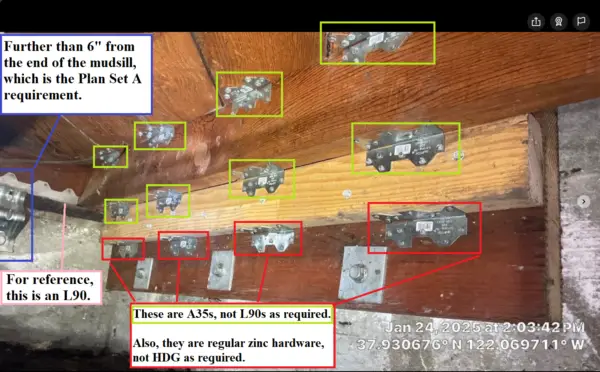
This L90 was missed altogether. This was actually only about 3′ from the crawl space access point. The FRFP was installed sometime in the past before the URFPs were added. The FRFP was installed with incorrect spacing and with incorrect hardware. Further, the URFP is installed too far from the edge of the wood.
Violation-13
The URFP is installed too far from the edge of the wood.
Violation-14
This URFP was installed too close to the edge of the wood and split the mudsill.
Violation-15
One of the nails is missing altogether.

Industry Reality Check

The examples below come from publicly posted photos of other contractors’ retrofit work.
We’ve annotated them for educational purposes only. They highlight three serious, industry‑wide problems:

  1. Code violations shown as “marketing”
    These publicly available photos clearly conflict with published building codes, Plan Set A details, and/ or manufacturer installation requirements, yet they are used as advertisements.
    This reveals a major gap between what is required on paper and what is actually being installed in the field.

  2. No true seismic retrofit license or rigorous training
    There is currently no dedicated seismic retrofit license category.
    Most “training” consists of simple, open‑book online modules that can be completed in a short sitting and result in a “FEMA/EBB‑trained” label.
    This does not equal deep, hands‑on experience with older Bay Area homes.

  3. Limited inspection and enforcement
    In our experience, many retrofits receive only cursory inspection. As we find with work done by others, serious deviations from plans or manufacturer instructions are often missed.
    Even when repeated issues are documented and reported, removal from public program lists appears to be extremely rare.


Our goal with the Seismic Truth Audit is to give homeowners something better than opinions or insufficient building inspections: photo documentation, drawings, and specific code/manufacturer citations, so you can actually see what was done with full information.

A seismic retrofit done incorrectly does not even provide the minimum required protection.