Strong Tohoku Quakes and Tokyo’s New Disaster Plan: What Bay Area Homeowners Should Learn
San Francisco Bay Area
June 24, 2026
Japan just got another loud reminder that earthquake risk doesn’t “expire.”
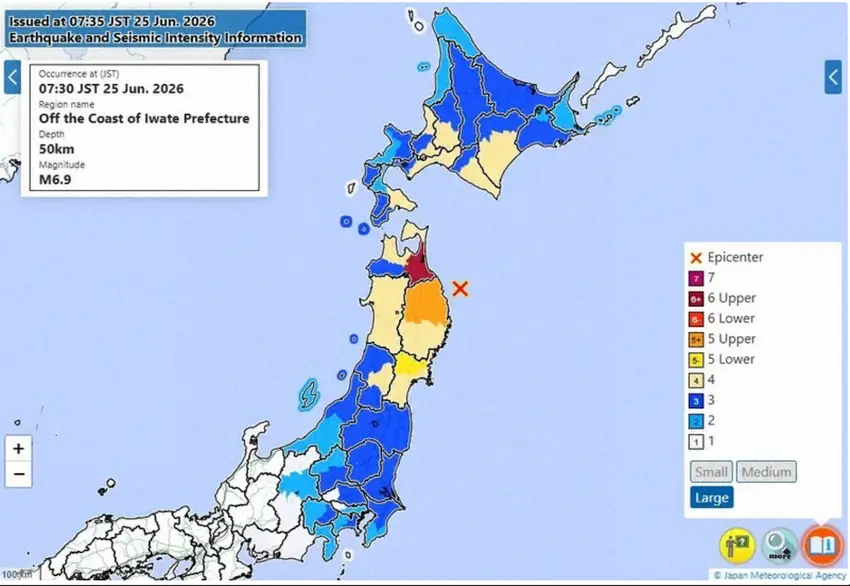
On June 24, 2026, a magnitude 6.9 earthquake struck off the eastern coast of Iwate Prefecture in northern Japan, shaking parts of the Tohoku region and triggering alerts across a wide area. No major tsunami was expected, but it was felt strongly along the coast and in cities that still remember 2011 all too well. (apnews.com)
This came just weeks after an M7.5 Sanriku earthquake off the same northeastern coast on April 20, which produced tsunami warnings, evacuations for more than 170,000 people, and structural damage in multiple prefectures. (en.wikipedia.org)
At the same time, a new editorial from Japan Forward laid out Tokyo’s updated megaquake plan: a push to halve projected deaths and building losses, a new national disaster management agency with more teeth, and a big emphasis on fire prevention and seismic breakers in buildings. (japan-forward.com)
If you own a home in the San Francisco Bay Area, this combination – repeated Tohoku shocks and Japan’s aggressive planning – should get your attention.
Quick Recap: What’s Happening in Northern Japan
Key points from recent events:
- June 24, 2026 – M6.9 off Iwate
- Offshore, about 50 km deep.
- Strong shaking in coastal Tohoku, widely felt across northern Japan.
- No major tsunami; limited physical damage reported so far. (apnews.com)
- April 20, 2026 – M7.5 Sanriku earthquake
- Offshore along the Japan Trench, same broader region as 2011.
- Tsunami warnings and advisories issued; evacuations for tens of thousands of households.
- Damage to buildings and infrastructure in several prefectures. (en.wikipedia.org)
- Context: Tohoku has shown elevated rates of M≥5.5 earthquakes in recent years, forming a wide ring of ongoing seismicity around the 2011 rupture area. (reddit.com)
Bottom line:
- Japan is experiencing persistent, significant seismic activity in and around the 2011 Tohoku zone.
- Their government is treating this as an ongoing risk management problem, not a one‑and‑done event.
Tokyo’s New Megaquake Plan: What Stands Out
The Japan Forward editorial outlines how Tokyo is updating its disaster plan for a potential direct metropolitan earthquake: (japan-forward.com)
- Scenario: Up to 18,000 deaths and about 400,000 buildings destroyed/burned if a major quake hits directly under the capital.
- New target: Cut both deaths and destroyed buildings by more than half over the next decade.
- Why the change: The previous 10‑year plan only achieved a 20–30% reduction, largely because building strengthening and fire‑prevention didn’t advance fast enough.
- Probability: Around 70% chance of a major Tokyo metropolitan quake within 30 years.
Key policy shifts:
- Stronger central coordination
- A new disaster management agency with the authority to push ministries and local governments that are falling behind.
- Fire gets top billing
- Roughly 70% of projected deaths and building losses in the Tokyo scenario are from fire, not collapse.
- Plan focuses on wide adoption of seismic breakers – devices that automatically cut power when strong shaking is detected, to prevent post‑quake electrical fires.
- More measurable goals and annual reviews
- Many more numerical targets, with progress checked every year instead of every decade.
- Fighting misinformation
- Explicit commitment to counter disaster‑related misinformation online, because bad information during and after a quake can cost real lives.
Japan is not just saying “earthquakes happen.” They’re setting clear performance goals and pushing building‑level mitigation hard.
Lessons for the Bay Area: Risk, Government, and Your House
We’re not Tokyo. But the core ideas carry over.
A. Risk is persistent, not event‑based
Japan’s experience shows that even 10+ years after a megaquake, you can still get:
- Major offshore events (M7+),
- Local tsunamis, and
- Urban impacts from shaking.
For the Bay Area, the Hayward and San Andreas systems haven’t ruptured in a long time. That doesn’t mean they’re benign – if anything, it makes them more worth planning around, not less.
Start with understanding your own house:
- Does My Home Need an Earthquake Retrofit?
- Your Home vs The Next Earthquake: A Practical Guide for Bay Area Owners
B. Codes and city plans are not enough
Tokyo’s previous 10‑year plan under‑delivered. They had codes and policies, but building upgrades didn’t move fast enough.
The Bay Area is in a similar boat:
- Code minimum is about life safety, not “no damage” or “stay in your house after.”
- Many older homes have never been brought to current standards, even at a basic level.
We talked about this here:
Why Building Codes Aren’t Enough for Seismic Activity
C. Fire risk deserves as much attention as structure
Tokyo’s plan treats fire as 70% of the problem in a metro quake. That’s not out of the question for us either:
- Gas leaks
- Water heaters tipping
- Faulty or overloaded electrical systems
- Blocked streets and hydrant issues
You can borrow Tokyo’s logic at the house level by:
- Strapping your water heater
- Installing seismic gas shutoff valves
- Talking to an electrician about easy shutoff access
- Clearing obvious fuel loads around the home
We wrote a simple homeowner guide for this:
How to Prevent Fires After an Earthquake
D. You need your own performance goals
Tokyo is aiming to cut deaths and destroyed buildings in half. What’s your target for your house?
- “I just don’t want it to collapse”?
- “I want it repairable”?
- “I want to stay here after the quake”?
That answer drives:
- How much retrofit you do
- Whether you stop at a minimum brace‑and‑bolt or pursue a full load‑path retrofit
- How much you invest in nonstructural safety and fire
We walk through those decisions here:
How to Set Earthquake Performance Goals
What Bay Area Homeowners Can Do This Week
You can’t create a national disaster agency or rewrite the code. But you can absolutely:
- Understand what you have
- Never retrofitted:
- “Retrofitted,” but you’re not sure how well:
- Fix obvious internal vulnerabilities
- Water heaters, bookcases, cabinet latches, heavy items over beds, unsecured TVs
- Gas and electrical safety as in How to Prevent Fires After an Earthquake
- Plan structural work in the right order
- Drainage and moisture (if bad)
- Foundation condition
- Seismic retrofit (crawl, soft‑story, basements)
- Finishes last
Good starting points:
- Seismic Retrofit vs Foundation Repair: Which Comes First in the Bay Area?
- Seismic, Foundation & Drainage Services
The Takeaway
Japan is dealing with:
- A string of significant quakes in Tohoku, including an M7.5 and M6.9 in the same region within months, and
- A sobering forecast of a major Tokyo metropolitan quake with huge potential losses. (apnews.com)
Their response is not to shrug and hope. It’s to:
- Tighten their plans
- Focus hard on building‑level mitigation
- Aim for clear performance targets (fewer deaths, fewer destroyed buildings)
- Treat fire and misinformation as core parts of the seismic problem
The Bay Area should be thinking the same way at every scale – region, city, and homeowner.
You can’t control when the next big quake hits. You can absolutely control whether your house, your systems, and your family are walking into it blindly, or with a plan.
If you’re ready to move from “concerned” to “doing something,” that’s where we live every day:
Seismic, Foundation & Drainage Services