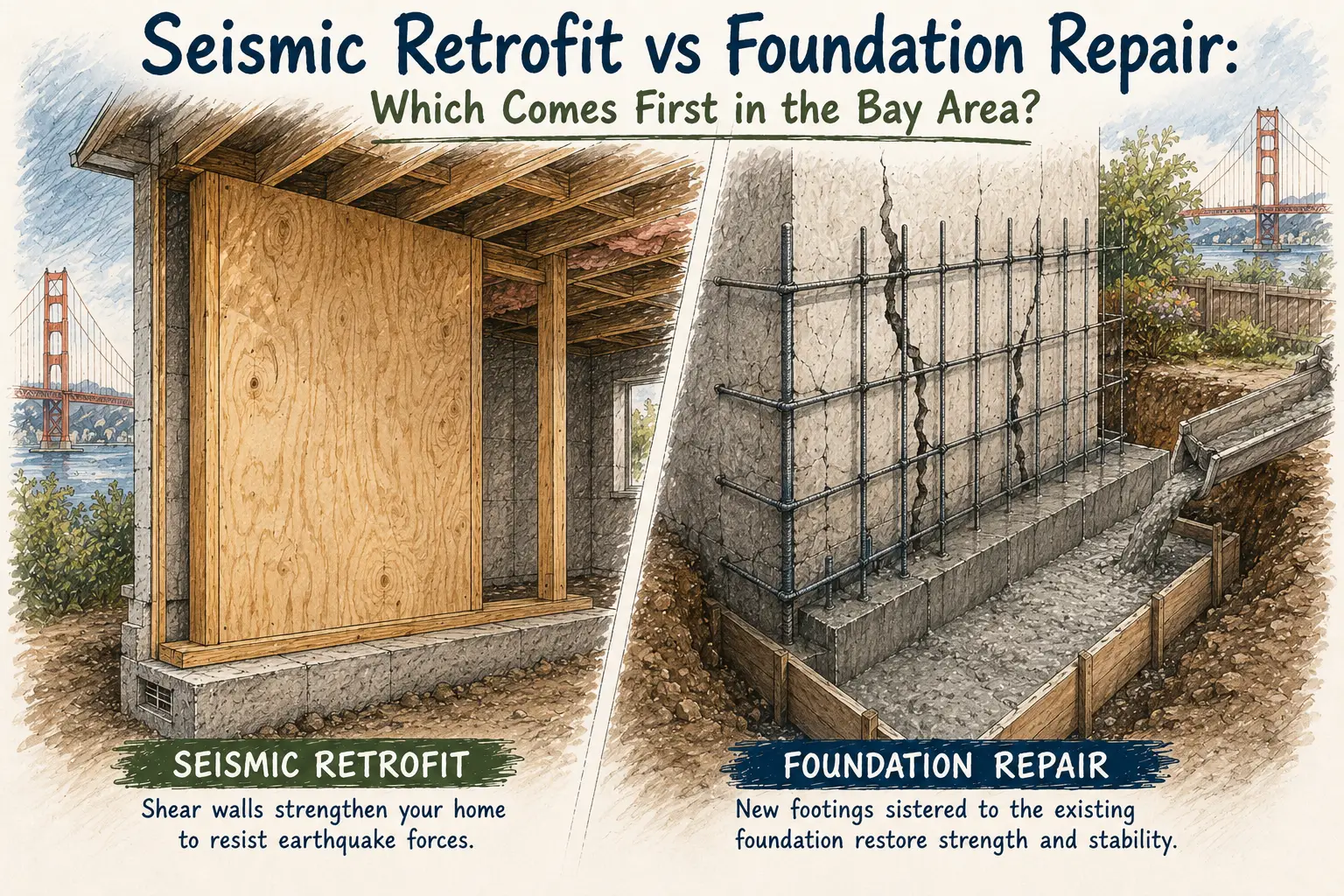
Seismic Retrofit vs Foundation Repair: Which Comes First in the Bay Area?
If you own an older Bay Area home and you’ve had anyone serious look at it, you’ve probably heard both:
- “You really should do a seismic retrofit.”
- “Your foundation needs repair or replacement.”
So the real question becomes:
“Do I retrofit first, fix the foundation first, or somehow do both?”
Get this order wrong and you can waste tens of thousands of dollars, or end up retrofitting twice.
This article gives you a practical way to decide what comes first for your house.
1. What Seismic Retrofit Actually Addresses
A proper seismic retrofit is about:
- Creating a continuous load path from roof → walls → cripple walls → mudsills → foundation
- Adding the right hardware and shear elements where the house is weak
- Keeping the structure on and with the foundation when the ground moves
Retrofit work focuses on:
- Cripple wall bracing
- Foundation‑to‑mudsill connections (anchors, plates)
- Framing connectors (clips, straps, collectors)
- Sometimes soft‑story frames and engineered elements
More on how we approach this as part of a full system:
Seismic, Foundation & Drainage Services
2. What Foundation Repair / Replacement Addresses
Foundation work is about:
- Making sure the thing you’re bolting to is worth bolting to
- Correcting movement, cracking, and deterioration
- Restoring proper support and alignment for the structure
Foundation work can include:
- Localized repair / underpinning
- New grade beams and interior supports
- Perimeter capping/sistering
- Full perimeter replacement
Details and cost ranges:
Foundation Services: Repair, Replace & Reinforce in the Bay Area
Water Damage in Concrete Foundations: Causes & Signs
3. The Simple Rule: Fix the Base Before You Bolt to It
In general:
- If the foundation is structurally compromised, foundation work must lead or be done alongside seismic.
- If the foundation is generally sound, seismic can lead, and foundation issues (if any) can be monitored or handled later.
Foundation should go first or alongside when you see:
- Significant cracking, spalling, or delamination
- Mudsills at or below grade, with rot or termite damage
- Obvious settlement or heave (sloping floors, stepped cracks)
- Serious water issues around or under the house
Trying to “save money” by retrofitting straight onto a failing foundation usually means you’ll:
- Pay for a retrofit now
- Pay again later to undo and redo work when the foundation is finally addressed
We cover that scenario here:
Can You Retrofit Over a Bad Foundation?
4. When Seismic Retrofit Can Come First
There are situations where retrofitting first is reasonable:
- Foundation has only minor, stable cracking
- No signs of significant movement (no worsening slopes, no big new cracks)
- No chronic standing water or heavy efflorescence
- Mudsills and lower framing are sound and above grade
In those cases, especially if budget is limited, it can make sense to:
- Prioritize life‑safety retrofits now (Plan Set A/FEMA‑informed work)
- Monitor foundation over time
- Plan for drainage or targeted foundation work later
The key is honesty: everyone involved should be clear that the retrofit is being done on current conditions, not pretending the foundation is perfect.
5. Where Drainage Fits Into the Order
You can’t talk about “which first, retrofit or foundation” without asking:
“Is water driving the foundation issues?”
If you have:
- Standing water under the house
- Saturated soils near footings
- Clear water paths from roof / hardscape to the foundation
…you’re dealing with a drainage problem as much as a foundation problem.
Often the correct order is:
- Surface drainage and downspout fixes
- French drains / sump systems where needed
- Foundation repair / reinforcement
- Seismic retrofit or corrections
More on drainage:
Drainage & Moisture Control
Drainage, Waterproofing & Basement Services in the Bay Area
6. When You Truly Need Both at Once
Some homes are too far gone for a clean “first this, then that.”
You may need integrated foundation + seismic work when:
- You’re replacing large sections of the foundation anyway
- You have a soft‑story or hillside condition plus deterioration
- The house has multiple additions and irregular geometry
In those cases, it’s usually smarter to:
- Design foundation and seismic together
- Install seismic hardware and framing corrections as you build the new foundation
- Bundle drainage improvements while everything is open
Yes, it’s more expensive. It’s also the only way to avoid paying for three disjointed half‑solutions over 10–15 years.
7. Why You Can’t Decide the Order from a Free 10‑Minute Visit
You cannot set the right sequence (retrofit first vs foundation first) from:
- One look through the hatch
- A quick lap around the house
- A single “free estimate” that ignores drainage and soil behavior
A real answer requires:
- Full crawl‑space inspection (if accessible)
- Inside/outside foundation assessment
- Drainage and grading review
- Correlation with interior symptoms (slopes, cracks, sticking doors)
- A clear recommendation for:
- Retrofit first
- Foundation first
- Or integrated project
That’s why we differentiate quick bids from actual evaluations:
Free Estimates vs. Real Evaluations
Why Site Consultation Fees Are Worth It for Seismic Work
8. What To Do Next
If you’re in the Bay Area and unsure which way to go:
- Stop trying to decide the order in a vacuum.
You need a combined seismic + foundation + drainage lens. - Schedule a real evaluation.
Start here:
Seismic, Foundation & Drainage Services - Ask explicitly in that visit:
- “If this were your house, would you retrofit first, fix foundation first, or plan a combined project?”
- “What’s my minimum safe path vs the ideal path?”
The right sequence is the one that fixes the base you’re standing on and then locks the house to it – in that order. Everything else is just arguing over how fast you want your money to evaporate.