Why Structural Screws are Better than Nails for Seismic Retrofits
When upgrading your home’s seismic protection, an overlooked decision is with hardware. Typically, this is between structural screws vs nails.
When and how you use them matters, however. Much more than homeowners think. Therefore, here’s a complete comparison guide:
What Are Structural Screws
Structural screws are heavy-duty wood screws. Unlike ordinary desk or drywall screws, structural screws are rated to meet building code standards (ICC-ES AC233) for shear, withdrawal, and cyclic loads in connectors.
Benefits of Using Structural Screws for Seismic Retrofits
Higher Withdrawal (Uplift) Capacity
Using structural screws for seismic retrofitting is ideal because they provide very high withdrawal (aka tension) rates. This is because their coarse threads deform the wood and create strong friction.
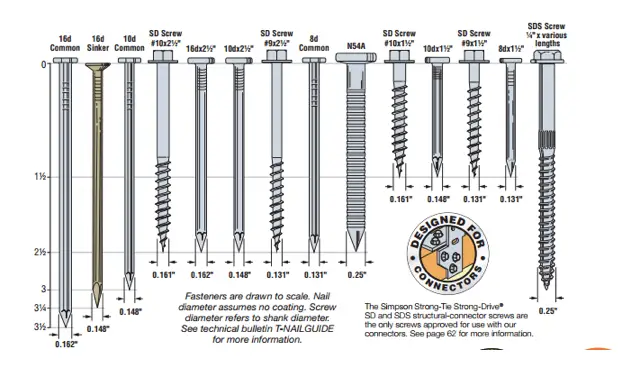
Due to how they are engineered, it’s known that screws of all types “are more resistant to withdrawal than nails”. For example, something like a ¼” Simpson SDS screw will have a far greater cross-sectional area and yield strength than a general 10d or 16d nail, so it can resist uplift better.
For retrofits, this is incredibly important. Overturning moments may try to lift a mudsill or hold-downs. Using structural screws, however, can ensure uplift is prevented.
Greater Shear Strength and Stiffness
Generally, structural screws are made of high-strength alloy and are often thicker than nails. This, in turn, can result in higher lateral (shear) capacity in connections.
Alongside this, structural screws normally yield less under load, so they are stiffer. This means that screw-fastened joints slip less before resisting force.
Ease of Installation and Consistency
Modern structural screws, for example, Strong-Drive SDS, have self-drilling points and coarse threads. By having these features, these screws can be quickly driven into wood using power tools without any pilot holes.
In retrofit work, like installing a retrofit foundation plate, these screws can hold hardware tightly with minimal to no wood damage. This makes them ideal for installation, making it a consistent and seamless process.
Corrosion Resistance and Durability
In the market, structural screws are available in all types of materials, including high-quality steel and stainless grades.
With such options, you can choose structural fasteners based on your circumstances. For example, for external or untreated wood, 316 stainless steel or triple-barrier coating screws are recommended.
By having different materials available, you’re able to select fasteners that remain corrosion resistant and durable overtime.
Negatives of Using Screws for Seismic Retrofits
Higher Cost & Slower Installation
Unfortunately, structural screws are more expensive than nails. Not only this, but they take more time to install.
What Are Nails
Nails are straight steel pins that are driven into wood (via a hammer or nail gun) to fasten members together. For seismic retrofits, contractors typically use 10d or 16d bright steel nails to attach plywood shear panels, blocking, and to secure connectors like angles and straps.
Benefits of Using Nails for Seismic Retrofits
Fast, Easy Installation
Nailing is remarkably quick. Much quicker than drilling in a screw. All the contractor needs to do is drive nails in with a hammer or battery/ pneumatic nailer, which can be done in seconds.
Due to a large quantity of nails being able to be installed in minutes for work like nailing framing or seismic connectors, it can speed up retrofit work.
Proven Track Record and Code Acceptance
Since the beginning of retrofits, nails have been covered extensively in building codes and reference guides.
There are even organizations like the International Staple, Nail, and Tool Association that offer fastening advice for using nails for specific retrofitting work.
Because of this, it’s a clear indication that, despite being much different to screws, they’re still compliant for many parts of a retrofit project.
Cost-Effective Materials
Typically, nails are cheap.
For a project like a retrofit, sometimes, thousands of fasteners are used, for example, for blocking, sheathing, and strapping. Therefore, using nails for such work could save you some money.
Negatives of Using Nails for Seismic Retrofits
Lower Withdrawal (Tension) Resistance
Nails, for example, smooth-shank type like 10d, offer much lower pull-out strength compared to structural screws. Even ring-shank or spiral nails can’t match the withdrawal resistance of a structural screw.
In seismic retrofits, uplift force matters. With such installations, nails are less effective and not recommended.
Prone to Loosening and Moisture Effects
Over time, nails can loosen. This is mainly due to wood expansion and contraction from moisture changes.
For example, in a damp crawl space or with green lumber, withdrawal capacity can decrease as much as 75% with nails. Therefore, nailed joints can weaken over the years.
Wood Splitting and Damage
Driving large nails near the edges of wood or into dry framing can cause splitting. This, as you can imagine, can reduce the structural integrity of the wood.
While there are specialized nails that can reduce risk, they still require more impact force than screws, which can increase the chances of damaging the material.
Connector Restrictions
Alongside the above, some retrofit connections aren’t rated for nails and require specific fasteners like screws or bolts. If you use the wrong type of nail or any fastener, you can void the load rating of the hardware and void building compliance.
Comparing Structural Screws vs Nails for Seismic Retrofits
Should You Use Structural Screws or Nails for Seismic Retrofits?
For most modern seismic retrofits, structural screws are a much more superior choice.
Use Structural Screws When:
- You need maximum withdrawal strength, for example, mudsill-to-framing or hold downs.
- You’re working in tight crawl spaces or with aged/dry lumber that can be prone to splitting.
- When long-term durability and precision are a specific priority.
- You’re installing connectors that especially require or allow approved structural screws.
- You want fasteners with greater strength per piece.
Use Nails Only When:
- Nailing Shear panels.
- Speed and cost-efficiency of framing + connectors are more important than peak performance.
Contact Us
As you can see, using structural screws are the superior choice for framing & connectors.
To perform a successful seismic retrofit, you will first need properly designed seismic retrofit plans.
At Avant-Garde, we can help with both. We can develop code-compliant designs as well as execute them. For more information about how we can help, contact us today.