How to Select Materials for Corrosion Resistance
Metal hardware is what keeps every structure together. However, despite this, it’s also one of the first components to fail when exposed to the wrong conditions, causing corrosion.
Many homeowners are often surprised when they see rusted bolts, screws, or connectors in seemingly “dry” places. Though dry, stress corrosion can slowly damage the hardware through tension, humidity, and chemical exposure.
Because of this, it’s important to use the right hardware in the right location. That’s why we’re going to compare the main hardware materials on their stress corrosion resistance below.
What is Stress Corrosion
Stress corrosion is a form of metal deterioration that happens when metal under tensile stress is exposed to a corrosive environment, like moisture or chemicals. Over time, the combination of stress and a corrosive environment can cause microscopic cracks and corrosion that wouldn’t occur with stress or moisture alone.
The Problem with Standard Hardware
Homeowners are often surprised when they find rusty screws, bolts, or plates in areas that seem dry. For example, crawl spaces may not show visible water, yet wood near the ground often holds enough moisture to corrode standard hardware over time.
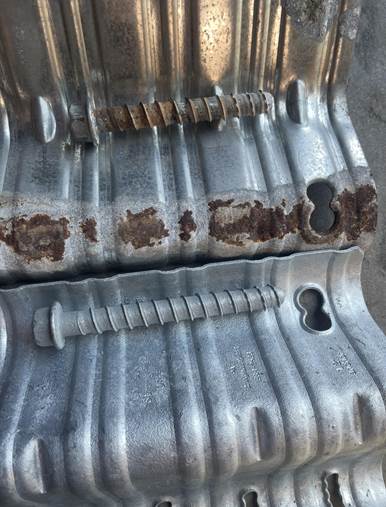
Accordingly, we’ve seen zinc-coated hardware rust in just two years in a “dry” crawl space. Zinc, however, is the industry-standard. In the image below:
Zinc Fastener Above After Two Years of Usage in Dry Crawl Space (contact with redwood mudsill and concrete foundation, no contact with pressure treated lumber), and HDG URFP Hardware Below
Hardware Material Comparison for Stress Corrosion
Not all metal hardware is created equal. Different materials and coatings offer varying levels of protection and performance.
Regular Steel
- Corrosion Resistance: Low
- Durability: Low
- Cost: Low
- Code Acceptance: Low
- Environmental Suitability: Dry interior only; not for crawl spaces, exterior, concrete contact, or pressure-treated wood.
Regular steel, often called bright steel, is strong but completely unprotected against corrosion. Without any coating or galvanization, it quickly rusts when exposed to air, moisture, or contact with wood or concrete. Under stress, corrosion speeds up.
Therefore, this material is only recommended for completely dry indoor environments. Think of interior framing or furniture assembly. It shouldn’t be used for anything structural or anywhere that has humidity.
Zinc
- Corrosion Resistance: Low to Medium
- Durability: Low to Medium
- Cost: Low
- Code Acceptance: Low (generally interior, non-treated applications only)
- Environmental Suitability: Dry indoor areas or very mild conditions; must avoid exterior exposure and treated lumber; although allowed, it is recommended to avoid crawl spaces and contact with interior concrete due to possible corrosion.
Zinc-coated steel, also known as electroplated galvanized, offers a thin protective layer that delays rust. However, it doesn’t prevent it long-term. Once the layer wears off or if a crack appears, corrosion can speed up rapidly.
Generally, zinc fasteners are okay for dry interior applications, like framing or furniture. For outdoor projects or treated lumber, they must not be used. For crawl spaces or contact with interior concrete, they shouldn’t be used as the coating may begin to rust.
Mechanically Galvanized
- Corrosion Resistance: Medium
- Durability: Medium
- Cost: Low to Medium
- Code Acceptance: Medium when coating meets ASTM/ESR (e.g., Class 55/65)
- Environmental Suitability: Interior or light exterior; acceptable for some retrofit/concrete anchors; avoid coastal or continuously wet locations.
Mechanically galvanized hardware has a much thicker zinc layer than electroplated steel. Therefore, corrosion resistance is improved. The coating, though, is only mechanically bonded and can chip or flake under load, exposing the steel underneath.
For performance, it’s okay. It is the next step up from zinc for many hardware applications. Typically, it’s used for light exterior work or semi-protected environments. It can even be used as an upgrade to zinc for concrete anchors or retrofit work, depending on the environment.
Hot-Dipped Galvanized
- Corrosion Resistance: High
- Durability: High
- Cost: Medium
- Code Acceptance: High (commonly required for treated wood/exterior)
- Environmental Suitability: Exterior and damp areas, crawl spaces, treated lumber, and concrete interfaces; not ideal for severe marine spray zones.
Hot-dipped galvanized (HDG) hardware offers one of the most corrosion-resistant coatings available. The steel is deep in molten zinc, creating a thick, bonded layer that protects against moisture and stress corrosion.
Generally, it’s the industry-standard for decks, anything exterior, and treated-wood applications. In some cases it is required, but at least always recommended for all crawl space work and foundation retrofits. Due to how the coating is applied, it offers long-term performance even in humid or damp environments. Please note, not all hardware is available in this option.
Simpson Strong Tie’s ZMAX
- Corrosion Resistance: Medium-High
- Durability: Medium-High
- Cost: Medium
- Code Acceptance: High (G185-level heavy galvanization)
- Environmental Suitability: Exterior and treated-wood connections (decks, crawl spaces, seismic retrofits); good general choice short of harsh marine exposure.
Simpson Strong-Tie’s ZMAX uses heavy galvanization, around double that of zinc. This ensures that it resists corrosion from moisture and pressure-treated wood.
Mainly, this is used for exterior and high-humidity applications, like decks, crawl spaces, and seismic trusses.
GRK’s Climatek
- Corrosion Resistance: High
- Durability: High
- Cost: Medium
- Code Acceptance: High (AC257/ICC-ES approved as HDG alternative)
- Environmental Suitability: Exterior structural and treated-wood uses, including crawl spaces and most coastal neighborhoods; avoid direct marine immersion/submersion.
GRK’s Climatek coating is a multi-layer finish that combines zinc and polymer protection. Tested under AC257 and ICC-ES standards, it meets and exceeds the corrosion resistance of hot-dipped galvanized hardware.
Due to their high resistance levels to stress corrosion, they are ideal for exterior structural work, crawl spaces, and treated-wood applications. The only real limit is direct marine or underwater environments.
Stainless Steel
- Corrosion Resistance: High
- Durability: High
- Cost: High
- Code Acceptance: High
- Environmental Suitability: Best for coastal/foggy or continuously damp areas; ideal for treated wood, concrete interfaces, and long-life exterior work.
Stainless steel fasteners are an excellent option for corrosion resistance and longevity. Containing chromium and often molybdenum, they naturally resist rust and stress corrosion without needing any additional coating.
You get two main types of stainless: A2 and A4. A2 is resistant to all non-salty water, and A4 is for saltwater protection. Therefore, A2 is used for most damp locations and A4, more coastal environments.
Comparing Hardware Materials for Corrosion Side-by-Side
| Material | Corrosion Resistance | Durability | Cost | Code Acceptance | Environmental Suitability |
| Regular Steel | Low | Low | Low | Low | Dry interior only |
| Zinc-Coated Steel | Low-Medium | Low-Medium | Low | Low | Dry indoor or mild conditions |
| Mechanically Galvanized | Medium | Medium | Low-Med | Medium | Interior or light exterior |
| Hot-Dipped Galvanized (HDG) | High | High | Medium | High | Exterior, damp, and crawl spaces |
| Simpson Strong-Tie ZMAX® | Medium-High | Medium-High | Medium | High | Exterior and treated-wood use |
| GRK’s Climatek™ | High | High | Medium | High | Exterior, treated wood, coastal |
| Stainless Steel (A2/A4) | High | High | High | High | Coastal, foggy, or damp areas |
What Hardware Material Should You Use?
The right hardware material depends on where and how it’s used. For dry indoor areas, zinc-coated fasteners can be used. However, in crawl spaces, basements, and outdoor projects, upgrading to at least hot-dipped galvanized or Simpson Strong-Tie’s ZMAX hardware is recommended.
For homes that are near the coast or exposed to high humidity, stainless steel hardware and fasteners are the best options. These can resist stress corrosion and even damp or salty air (A4 stainless steel only)
Why Should You “Upgrade” Your Hardware Material
When compared to regular steel, the costs of other fasteners with better stress corrosion resistance levels are higher. Therefore, why should you consider the upgrade?
Prevent Costly Repairs
The main reason is that corroded fasteners and connectors can lead to serious structural damage over time. Replacing rusted hardware often means taking apart prior work, which can be labor-consuming and expensive.
Invest in better hardware now, prevent replacement in the future.
Invest in Durability
Upgraded materials like HDG, ZMAX, and stainless steel are built to last. They maintain their strength under tension, resist environmental wear, and prevent premature hardware failure, making them much more durable.
Protect Against Hidden Moisture
Even “Dry” areas like crawl spaces or basements often hold enough humidity to trigger corrosion. Upgraded hardware provides a safety margin against these threats, ensuring that your connections remain structurally sound for years to come.
Conclusion
Choosing proper hardware isn’t just about meeting the standard code. It’s about protecting your home’s structure for the long term.
Stress corrosion is a serious problem. Quietly, it can weaken connections in areas that may appear dry. Therefore, it’s highly important that you choose quality hardware materials from the get-go.
For most Bay Area homeowners, hot-dipped galvanized (HDG) and Simpson Strong-Tie’s ZMAX hardware is a good option. This balances cost and corrosion resistance perfectly. For more coastal areas, stainless steel (A4) hardware and fasteners are recommended. Upgrading your hardware today means avoiding costly repairs tomorrow.
For guidance with comparing hardware materials for corrosion or installation, feel free to contact our professionals at Avant-Garde