Bay Area Soft-Story Programs Compared: What San Jose Owners
Can Learn from SF, Oakland, Berkeley, Albany, and Fremont
If you own a wood-frame apartment building in the Bay Area, it can feel like every city has its own language for the same problem:
- “Soft-story”
- “Target story”
- “Wood-frame target story”
- “Weak-story,” “open front,” “tuck-under”
Underneath the jargon, the physics are identical:
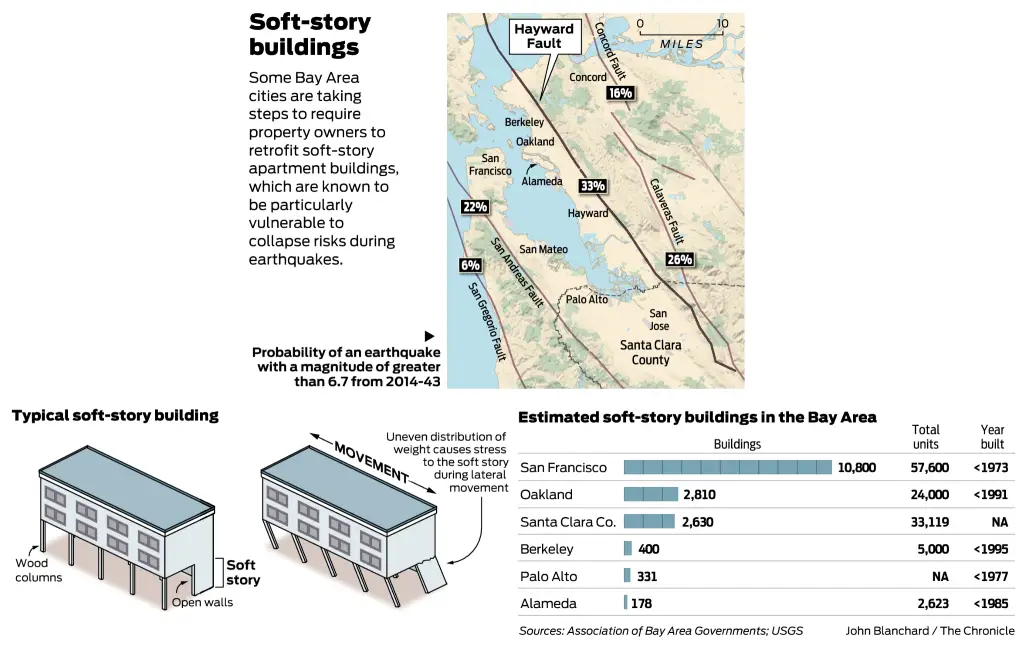
A weak, flexible ground story is holding up a heavier, stiffer building above it.
In a strong earthquake, that ground story is where things break first.
San Francisco, Oakland, Berkeley, Albany, Fremont, and now San Jose have all put soft-story programs or ordinances on the books. They didn’t do it all at once, and they didn’t do it the same way.
This article stacks them side-by-side so you can see:
- What each city did
- In what order
- What went wrong (and right)
- And, most importantly, what San Jose owners can steal from 20+ years of other people’s trial and error.
Same Problem, Different Cities
Every Bay Area city with a soft-story program is dealing with the same basic building type:
- Wood-frame construction
- Multi-unit (apartment/mixed-use) buildings
- With parking or open space at the ground floor
- And dwelling units above
These buildings failed dramatically in past earthquakes. Not because engineers didn’t know better – but because:
- They were designed under old codes
- Lateral loads (side-to-side shaking) weren’t the focus
- People maximized parking and storefront openings and minimized walls
The typical failure:
- Upper stories remain relatively intact
- Ground story racks or collapses
- Building ends up sitting on its carports, not its foundations
Every ordinance in this space answers the same question:
“Which of these buildings do we have, and how do we get them out of the collapse-in-the-first-story category?”
A Quick Timeline: Who Moved When?
Very roughly, the Bay Area soft-story timeline looks like this:
- Berkeley – mid-2000s:
- Phase I: inventory, professional evaluations, tenant warnings
- Phase II (2014): mandatory retrofits for certain wood-frame 5+ unit soft-story buildings
- Fremont – early 2000s onward:
- Hazard identified and soft-story ordinance adopted for residential buildings
- Focus on notification and voluntary compliance, integrated into seismic planning
- San Francisco – 2013:
- Mandatory Soft Story Retrofit Program (Ord. 66-13)
- ~5,000 wood-frame 5+ unit soft-story buildings required to retrofit in tiered deadlines
- Oakland – 2009 & 2019:
- 2009: mandatory screening (Ordinance 12966)
- 2019: mandatory retrofit (Ordinance 13516)
- Albany – more recently:
- Soft-story / Wood-Frame Target Story program for 3+ unit pre-1981 buildings
- Mandatory mitigation with clear definitions and deadlines
- San Jose – 2024 ordinance (effective 2026):
- New soft-story retrofit ordinance for certain wood-frame 3+ unit buildings
- Screening required by October 1, 2027
- Retrofit deadlines stretching into the early 2030s by group
San Jose is not starting from scratch. It’s coming after everyone else has already stubbed their toes.
Common Owner Mistakes Across All Cities
Different cities, same patterns of human behavior.
1. Ignoring the early letters
Owners received:
- Notices in Berkeley and Fremont
- Screening letters in Oakland
- Program Tier notices in SF
Many filed or ignored them until the last minute.
Then, when retrofit deadlines hit, they:
- Scrambled for engineers and contractors
- Fought for permit review time
- Tried to negotiate timelines after thousands of other owners had already moved
2. Treating retrofits as “a permit problem,” not a structural problem
- Some owners shopped for the cheapest proposal
- Ignored load paths, foundations, drainage, and utilities
That led to field surprises, change orders, and weaker outcomes.
3. Under-planning for tenants and parking
- Loss of parking
- Access disruption
- Noise and daytime impact
A retrofit only works if it works for the people living there.
Bottom Line
The Bay Area already ran multiple experiments in how to handle soft-story buildings.
- Berkeley: early evaluation, then mandates
- Fremont: early awareness, uneven follow-through
- San Francisco: large mandatory program
- Oakland: screening, then enforcement
- Albany: precise, structured program
San Jose now has the advantage of learning from all of them.
You can ignore that—or use it to get ahead of the curve.