Screw and Nail Spacing Matters More than You Might Think
For a seismic retrofit, plywood screw and nailing spaces matter more than a lot of people think.
These fasteners, if not correctly installed, can cause poor load balancing, split framing, shear wall failure, and more.
Because of this, understanding why screw and nailing spacing matters. Here’s why:
Maintains Shear Wall Integrity
Shear walls act as the “backbone” for seismic resistance. In short, they help reduce sideways shaking by acting as a rigid board that pushes the force down onto the foundation.
What creates this type of reinforcement is sheathing (aka plywood panels). However, this sheathing only works correctly if the nails or screws used are fastened correctly following proper patterns.
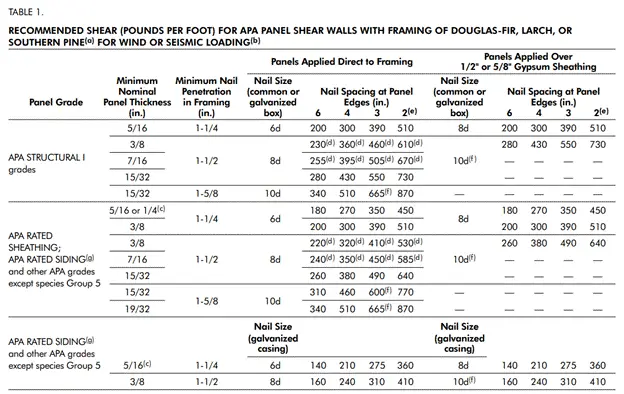
Shear wall test data from APA (The Engineered Wood Association) demonstrates this perfectly. It states that using 15/32” structural 1 plywood with 10d nails at 6” spacing holds about 340 plf; in contrast, using 15/32” structural 1 plywood with 10d nails at 2” spacing holds around 870 plf.
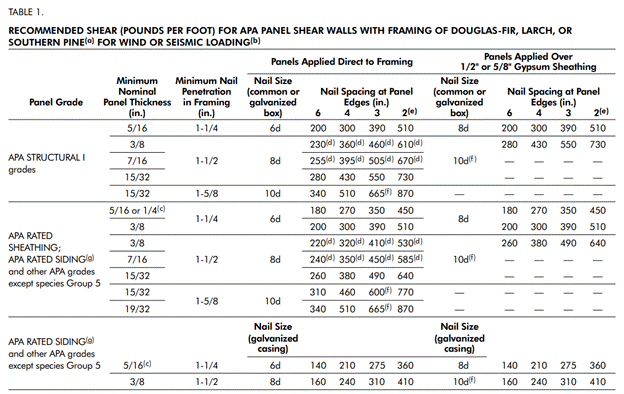
As you can see, by following a 2” nailing pattern for structural 1 plywood instead of a 6” pattern, you get an approximate 155% increase in shear wall fastening strength.
Prevents Splitting and Weak Points
Seismic retrofits usually occur on older properties. These are generally properties built before the 1980s.
Because of this, while carrying out such work, it’s common to encounter dry, brittle lumber around the foundation. Therefore, if a contractor isn’t careful, they can actually split this wood by not following proper screwing or nailing spacing, which will weaken the wood.
There’s even a code that recognizes this now. It says if nails are placed closer than 6” on-center (OC) on a panel, the adjoining framing must be 3” nominal or wider (for example, a double 2x stud) to prevent splits.
Despite these suggestions, though, contractors should avoid driving dense nails into old studs. A replacement for this would be to use structural screws. These can often be driven into the framing lumber without splitting the wood.
APA has done some research on this also. They say that using stables 1” apart on old-growth Douglas Fir or redwood studs didn’t cause splitting, which, in turn, increased the shear capacity of the installed plywood. While most contractors use nails, and some use staples, there is yet a better option.
Why Structural Screws Perform Better Than Nails or Staples in Older Homes
Structural screws are specifically engineered to address the exact weaknesses encountered during seismic retrofits of older buildings– namely dry, brittle framing lumber and limited edge distances.
Unlike nails or staples, which rely on displacement of wood fibers to develop holding power, structural screws are cutting fasteners. Their threads remove material in a controlled way rather than forcing it aside. This dramatically reduces radial stress in the wood, which is the primary cause of splitting in old-growth Douglas fir, redwood, and aged SPF lumber commonly found in pre-1980 construction.
In addition, structural screws are installed at much lower driving force than nails or staples. Nails and staples are typically driven at high impact energy (especially pneumatic fasteners), which can propagate micro-fractures in brittle framing– even if visible splitting does not immediately occur. Structural screws are installed under controlled torque, allowing the installer to feel resistance changes and stop before damage occurs.
From a performance standpoint, structural screws also provide superior load predictability. Their withdrawal resistance and shear capacity are derived from thread engagement rather than friction alone. This is why modern structural screws are tested and rated under ICC-ES evaluation reports and APA-recognized testing protocols, with published allowable loads that remain reliable even in dry or aged lumber.
This mirrors findings from APA – The Engineered Wood Association, which demonstrated that closely spaced fasteners (including staples at 1” on-center) could be used in old-growth Douglas fir and redwood without splitting when fiber displacement was minimized– resulting in increased shear capacity of the plywood assembly. Structural screws take this principle further by actively reducing fiber displacement through their cutting threads and controlled installation.
In practice, this means structural screws allow tighter spacing, higher effective shear transfer, and significantly lower risk of hidden framing damage– making them the preferred fastener for seismic retrofits in older homes where preserving the integrity of existing lumber is critical.
Preserves Framing Continuity
A shear wall is only as strong as its weakest link. Therefore, the load path must be continuous from the floor framing all the way down to the foundation. This means that every single connection within the framing must be connected. In advanced entire-home retrofits, all the framing starting from the roof is continuously connected down to the foundation.
If a top or bottom plate is interrupted, that break must be reinforced with nails or metal straps. However, the nail or screw pattern in the framing should match the plywood sheathing to avoid weak points and to ensure proper load transfer.
Hold-down anchors, for instance, should be installed at the ends of each shear wall. They should then be bolted to the foundation to prevent uplift. Again, sill plates should be anchored using URFP plates or 5/8” anchor bolts that are spaced no more than 32” on center (also within the first and last stud bays) within shear walls.
Generally, proper fastening and anchoring create a unified structure. Missing connections or using inappropriate screw or nailing patterns could be problematic under seismic pressure.
Building Code Requirements for Plywood Fastening
General Building Code
Most U.S. residential codes (IRC/IBC) already give some guidance on minimum fastening for wall sheathing.
For example, with structural plywood (7/16” or thicker), the standard fastening code is 8d common nails at 6” OC along all panel edges and 12” OC in the panel field. All nails should fall on a solid backing as well (stud or blocking) to ensure every fastener is connected to wood.
The framing within the shear panels must also be fastened with same edge requirements.
Further, the IRC also requires that panel edges have a ⅛” gap and nails be held at ⅜” from the edge of the board. This is to avoid splitting.
Seismic Building Code
Codes tighten these requirements in high seismic regions (IRC Seismic Design Category D/E/F).
For instance, the IBC/IRC suggests that if the design shear exceeds 350 plf, panel edge framing must be 3” nominal to transfer loads. Alongside this, only plywood ≥15/32” thick is generally permitted for shear walls in these regions.
Screw and nail spacing for this plywood is different as well. The California Residential Mitigation (Brace+Bolt) guidelines suggest 8d nails at 4” OC on edge and 12” field.
Adding to this is how panel joints and sill plates are nailed. Sometimes, these are required to be stagger-nailed to prevent splits when fasteners are close.
Bay Area-Specific Retrofit Codes and Recommendations
Where we are located, the Bay Area, is known for high seismic risk. At some point within the next 30 years, we’re likely to encounter an earthquake with a magnitude of 6.7 or higher.
Because of this, there are specific seismic retrofit codes in the Bay Area to reduce the cost and fatality of such an earthquake.
For example, the state-wide program, Earthquake Brace + Bolt (EBB), specifies ½” CDX plywood, 8d nails at 4” OC on edge and 12” in field.
Some cities within the region, for example, San Francisco and Oakland, may also require further engineering plans or special connections depending on the house.
We use 5-ply, ½” structural 1 plywood for all of our shear walls.
Best Practices for Nail and Screw Spacing in Seismic Retrofits
To ensure you follow the best nail and screw spacing techniques for seismic retrofits, you should:
1. Match Framing and Sheathing Fastening Patterns
Run screw/nails through studs, plates, and blocking with the same o.c. spacing as the plywood. This will allow for a smoother load balance.
For example, let’s say plywood edges get nails 3” apart. In this case, the top plate and mudsill blocks should also be fastened following the same 3” o.c. pattern so the seismic loads may be evenly distributed properly between all members.
2. Avoid Splitting Dry Lumber
With more seismic retrofit projects, you’ll be working on “older” homes. Sometimes these homes will date back to the 1950s.
Because of this, it’s common to encounter dry lumber. You can replace this. However, if you’re going to be working with old, dense studs, we recommend using structural screws– not nails.
Structural screws have higher shear values and withdrawal strength; they also have a lower chance of splitting wood than compared with nails.
If you’re going to use nails, be careful. Don’t cluster them. Stagger them more than you think, following a consistent pattern.
3. Always Back ALL Panel Edges
Every single edge on a plywood panel should land on a stud, plate, or solid blocking that’s at least 3” wide. This is a must for all fastener types.
Many contractors, inspectors, and even EBB often overlook this critical step.
By following this structural screw and plywood nail spacing technique, it ensures no fasteners will withdraw from the wood.
4. Address Gaps and Plate Breaks
If you encounter a break at the top or bottom plates, tie them together. You can do this by using nails, structural screws, or metal straps to reconnect split plates as applicable so the shear load can be passed through the gap.
5. Install Proper Hold-Down & Anchor Bolts
Hold-downs are used on tall walls to resist overturning. Every shear wall end also needs an anchor– use anchor bolts or retrofit plates sized for the wall height and loads. The corners, splices, and ends of shear walls are often overlooked by others when placing anchor bolts.
6. Use Approved Hardware
Without question, you should only be using fasteners and connectors that are rated for shear walls. This ensures you’re using materials that are specially designed for such an application. These have been tried and tested for seismic activity.
For example, with Simpson Strong-Tie, they actually test and publish shear values for their nails, screws, and connections. This guarantees that you’re using fasteners and hardware suited for the job.
7. Use Sheathing That Meets Grade
Shear wall screw and nail patterns are excellent to follow; however, do not use any type of plywood. Use structural-rated plywood like CDX or even better, structural 1 plywood.
For seismic zones like the Bay Area, plywood for this application should be 15/32” or thicker. Everything thinner is inadequate for the job.
Contact Us Today
Protecting your home from seismic activity starts with a proper design plan followed by professional execution.
At Avant-Garde, we can help you through every step of the process, from surveying to design, permitting, and development.
If you’d like to protect your home, family, and investment today, contact us. Waiting will be a helpful representative eager to help.